
A Thai Buddhist tradition of blessing, connection and mindfulness
One of the things I love about visiting Buddhist monasteries in Thailand is that sometimes the smallest moments become the most meaningful.
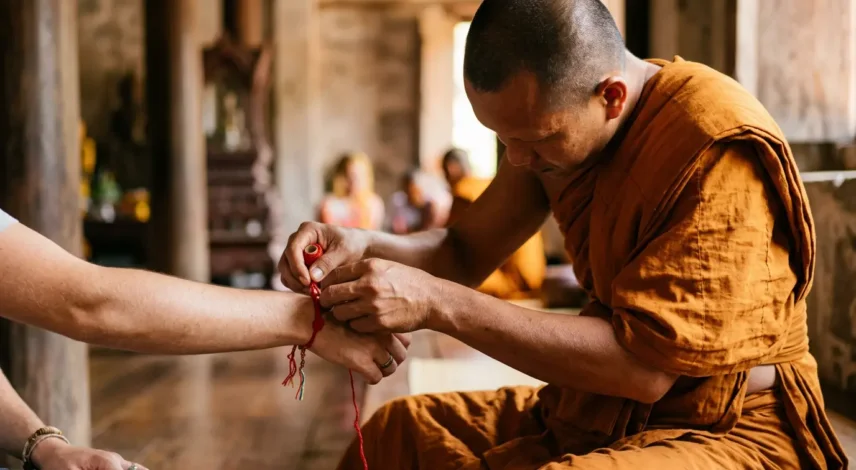
On one of our visits, the monks gave my students blessing bracelets to wear around their wrists. There was nothing complicated about it. A monk, a blessing and a simple thread.
But when I looked at everyone together afterwards, I saw something more.
Different people. Different cultures. Different journeys. One shared moment.
And that made me curious about the deeper meaning of Sai Sin.
What is Sai Sin?
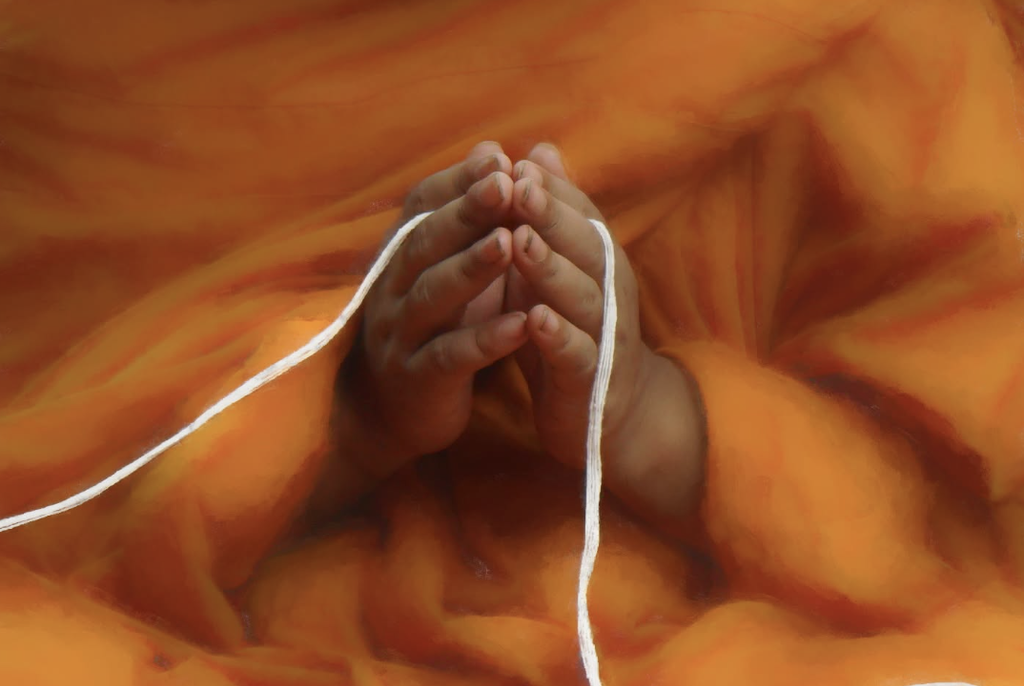
In Thailand, Sai Sin, written สายสิญจน์ in Thai, traditionally refers to a sacred cotton thread used in Buddhist ceremonies.
The thread is normally white, a colour associated with purity, although other colours and more decorative forms can also be seen depending on the region, temple and occasion.
Sai Sin may be blessed by monks and later tied around the wrist as a blessing associated with protection, well-being, health, good fortune and merit.
But Sai Sin is not only a bracelet.
In larger Buddhist ceremonies, a long thread may connect a Buddha image, the monks and the people taking part in the ceremony. During chanting, participants may hold or touch the thread.
Symbolically, the thread becomes a connection between the sacred space, the chanting, the monks and the people receiving the blessing.
I find this symbolism beautiful.
A single thread connects everyone.
A Symbol of Connection
Much of modern spirituality is often presented as something very individual.
My meditation.
My healing.
My journey.
My practice.
But Buddhist practice also reminds us that we do not exist independently.
There is the Buddha.
There is the Dhamma, the teaching.
There is the Sangha, the community.
There are teachers, friends, parents, strangers, nature and countless conditions that make our lives possible.
The thread can become a simple reminder of this.
I may be an individual, but I am not separate.
That is one of the things I see when I look at the photograph of all those wrists together.
Different people, connected by one shared experience.
The Importance of Three
The number three has an important place in Buddhism because it represents the Triple Gem:
Buddha
The awakened one and the possibility of awakening.
Dhamma
The teaching and the path of practice.
Sangha
The community of practitioners.
This is also why Buddhists traditionally bow three times in front of a Buddha image.
In some Thai traditions, people keep the Sai Sin bracelet around the wrist for at least three days, reflecting this connection with the Triple Gem.
Customs can vary between temples and regions, so there is not always one fixed rule.
More Than Good Luck
Sai Sin is often associated with protection, blessings, health and good fortune.
Some people may understand this literally.
Others may experience it symbolically.
For me, there is another way to look at it.
The bracelet can become a reminder.
During meditation, retreat or time spent in a monastery, we may experience moments of clarity.
We slow down.
We become quiet.
We remember what matters.
We may feel more patient, more grateful or more connected.
Then everyday life begins again.
Messages.
Work.
Relationships.
Plans.
Noise.
Distraction.
And very quickly, we forget.
A bracelet on the wrist can interrupt that forgetting.
You see it.
You remember the monastery.
You remember the blessing.
You remember the silence.
You remember how you felt.
And for a few seconds, you come back to yourself.
Why Rituals Matter
Physically, Sai Sin is only thread.
But human beings have always given meaning to simple objects.
A wedding ring is metal.
A mala is beads.
A photograph is paper or pixels.
A flag is cloth.
Yet none of these objects are experienced only as physical materials.
They can hold memory, love, commitment, identity and meaning.
Ritual works in a similar way.
An ordinary object becomes meaningful because of what happens around it.
The chanting.
The intention.
The person giving it.
The person receiving it.
The moment.
The memory.
This is one reason traditions like Sai Sin continue to have meaning.
They give physical form to something invisible.
Buddhism as a Living Culture
When many people first encounter Buddhism, they often learn about meditation, mindfulness, the Four Noble Truths or the Noble Eightfold Path.
These teachings are important.
But Buddhism in Thailand is also a living culture.
You can see it in the way people enter a temple.
The way they bow.
The way offerings are made.
The relationship between monks and laypeople.
House blessings.
Weddings.
Funerals.
Merit-making ceremonies.
Temple festivals.
Sai Sin is part of this larger cultural world.
It reminds us that Buddhism is not only something written in books.
It is not only something practised while sitting on a meditation cushion.
It has lived inside communities for generations.
Receiving Rather Than Collecting
When we travel, it is very easy to turn spiritual experiences into things we collect.
A temple photograph.
A bracelet.
A Buddha statue.
A retreat certificate.
Another experience to post online.
But entering a sacred place can be something different.
Instead of asking:
What can I get from this place?
We can ask:
What can I understand here?
Observe.
Listen.
Notice how people behave.
Notice how you feel when you become quiet.
Notice how monks and local people interact.
Notice what happens inside you when you slow down.
This changes the experience.
It becomes less about collecting and more about receiving.
How to Receive Sai Sin Respectfully
You do not need to be Buddhist to receive Sai Sin.
If a monk or local person offers you a blessing thread, receive it respectfully.
In Thai Theravada Buddhist culture, monks generally avoid direct physical contact with women, so you may notice that the thread is offered or tied carefully without touching the woman directly.
If you are unsure about what to do, simply follow the guidance of the monastery.
There is also no single rule for how long the thread must stay on the wrist.
Some people keep it for several days.
Some leave it until it becomes worn.
Some allow it to fall away naturally.
The temple where you receive it is always the best place to understand that particular tradition.
Turning the Bracelet Into a Mindfulness Practice
There is a simple way we can relate this tradition to everyday mindfulness.
This is not a traditional Sai Sin ritual. It is simply a practice I like.
Whenever you notice the bracelet on your wrist, stop for a few seconds.
Feel your body.
Relax your shoulders.
Notice one natural inhalation.
Notice one natural exhalation.
Then ask yourself:
What quality do I want to bring into this moment?
Patience?
Kindness?
Compassion?
Courage?
Awareness?
Letting go?
Then continue with your day.
It may only take ten seconds.
But sometimes ten seconds is enough to interrupt autopilot and bring us back into the present moment.
Eventually, the Thread Will Go
There is something else beautiful about these bracelets.
They do not last forever.
The colour changes.
The thread becomes softer.
It gets wet.
It becomes worn.
Eventually, it may loosen or disappear.
And there is a Buddhist teaching inside that too.
Everything changes.
Our bodies change.
Relationships change.
Emotions change.
Places change.
The bracelet itself changes.
This is anicca, impermanence, not as an abstract philosophy but as something we can see directly.
Perhaps we do not need to keep the thread forever.
What matters is whether something from the experience remains in the way we live.
More Than a Bracelet

When I look at the photograph now, I do not simply see bracelets.
I see students from different backgrounds sharing the same moment.
I see Thai culture being passed on through a simple gesture.
I see the generosity of the monks.
I see tradition.
I see connection.
And I see a reminder of something meditation continues to teach me.
The deepest teachings are not always complicated.
Sometimes they are very simple.
A breath.
A bow.
A moment of silence.
A kind gesture.
A thread around the wrist.
The thread itself is not the practice.
It reminds us to practise.
To breathe.
To be present.
To be kind.
To remember what matters.
And perhaps most importantly,
to remember that we are connected.
Aravind
Breathe With Aravind